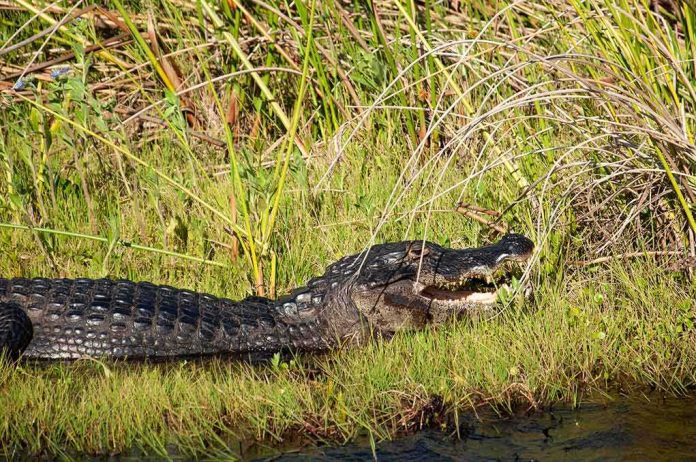
A quiet fishing trip on the shore of Lake Apopka turned deadly when a nearly 12-foot alligator attacked and killed a 71-year-old Florida man, forcing rescuers to fight past more gators just to pull his body from the water.
Story Snapshot
- Steven Hamilton, 71, of Winter Garden, died after an alligator bit him while fishing at Dr. Bradford Memorial Park.
- Rescue crews had to work around other alligators in the water, delaying recovery of his body by about two hours.
- Florida wildlife officers removed an 11-foot-8-inch alligator from the area as a safety measure.
- Winter Garden police and the Florida Fish and Wildlife Conservation Commission are jointly investigating.
Fisherman Attacked Along Lake Apopka Shoreline
Winter Garden police and fire crews rushed to Dr. Bradford Memorial Park around 5 p.m. after a 911 call reported an alligator attack. The Florida Fish and Wildlife Conservation Commission (FWC) said Hamilton, a longtime Winter Garden resident, was fishing near the south side of Lake Apopka when the animal bit him. Responding personnel pronounced him dead at the scene.
Officials said Hamilton was fishing from the shoreline, not swimming, when the alligator struck. Winter Garden officials told local reporters he was near a pond connected to the lake, and he was reportedly bitten on the leg before being pulled toward the water. The exact sequence of events has not been laid out in full detail by investigators.
Rescue Crews Battled More Gators to Recover Body
Winter Garden Fire Chief Jose Gainza said the presence of other active alligators in the water complicated the rescue effort. Crews could not simply wade in after Hamilton. It took roughly two hours before his body was finally recovered from the lake, a grim reminder of how dangerous these waters can be for anyone trying to help.
For a community used to seeing alligators as part of everyday Florida life, the scene was a stark warning. Lake Apopka and its surrounding ponds are known gator habitat, and responders had to weigh public safety against the urgency of recovering a man’s body from a lake full of predators.
Wildlife Officers Remove Nearly 12-Foot Alligator
The FWC confirmed that a contracted nuisance-alligator trapper removed an alligator measuring 11 feet 8 inches from the area. Winter Garden police described the animal as nearly 12 feet long and said it was taken out because it posed a danger to the public. Reports differ slightly on whether the animal was “removed,” “dispatched,” or “killed,” language that likely reflects the same outcome described in different ways.
Winter Garden police and the FWC are now jointly investigating the attack, a standard step whenever a fatal encounter with wildlife occurs on public land. Florida law gives the FWC authority to remove alligators deemed a threat under its Statewide Nuisance Alligator Program, which exists specifically to protect the public when an animal becomes a danger near homes, parks, or waterways.
Florida’s Alligator Attacks Remain Rare But Deadly
Hamilton’s death adds to a long but relatively short list of fatal alligator encounters in Florida. State records show nearly 500 reported human-alligator incidents since 1948, with 32 resulting in death. In 2025 alone, Florida logged 13 attacks, including two fatalities, numbers that have stayed in the low teens for most of the past decade.
A fishing trip turned fatal for a Florida man, 71, who was killed by a nearly 12-foot alligator along the shore of Lake Apopka in Winter Garden.
Emergency crews attempted to rescue the victim, but couldn't reach him because other alligators were also in the water, according to… pic.twitter.com/AMSAjhxqaR
— Fox News US (@FoxUSNews) October 18, 2026
Researchers at the University of Florida have found that in 96 percent of recorded bite cases, some form of human inattention or risk-taking played a role, not unprovoked aggression by the animal. That statistic doesn’t diminish the tragedy of Hamilton’s death, but it underscores a simple truth conservatives have long respected: nature carries real risks, and personal awareness matters more than government warning signs ever could.
Florida’s outdoorsmen have fished these waters for generations, and most understand the tradeoff that comes with living alongside apex predators. This tragedy is a sober reminder for anglers, campers, and families enjoying the state’s lakes to stay alert, respect wildlife boundaries, and trust the judgment that comes from experience rather than relying solely on government oversight to keep them safe.
Sources:
foxnews.com, wftv.com, nbcnews.com, people.com, wdsu.com, news-journalonline.com, myfwc.com