China’s ability to cut the cables that carry America’s internet and trillions in daily financial activity is the kind of quiet leverage that can cripple a nation without firing a shot.
Story Snapshot
- China’s Ministry of Natural Resources confirmed a deep-sea test of equipment described as capable of slicing armored undersea cables at 3,500 meters.
- U.S. officials and former defense personnel warn submarine cables are a prime “gray-zone” target because attacks can be masked as accidents.
- Sen. John Barrasso and Sen. Jeanne Shaheen introduced the Strategic Subsea Cables Act of 2026 to harden and increase resilience of this infrastructure.
- Lawmakers and analysts cite that about 99% of global data traffic and roughly $10 trillion in daily financial transactions depend on these cables.
A Critical Chokepoint Beneath the Ocean
Subsea fiber-optic cables are not a tech-world luxury; they are the physical backbone of modern communications and commerce. Roughly 99% of global data traffic moves through these lines, spread across more than 400 cable systems worldwide. When those cables function, Americans rarely think about them. When they fail, payment systems, cloud services, news, and even routine business communications can be disrupted in ways that ripple fast.
Sen. John Barrasso has tied the risk to dollars-and-cents reality by highlighting estimates that around $10 trillion in daily financial transactions rely on these cables. That figure is not a tally of guaranteed losses from a cut, but it illustrates dependence: trading, cross-border payments, and settlement systems assume fast, reliable connectivity. In a crisis, even short-lived outages can raise uncertainty, widen market spreads, and slow decisions across sectors.
China’s Reported Deep-Sea Cable-Cutting Test Raises the Stakes
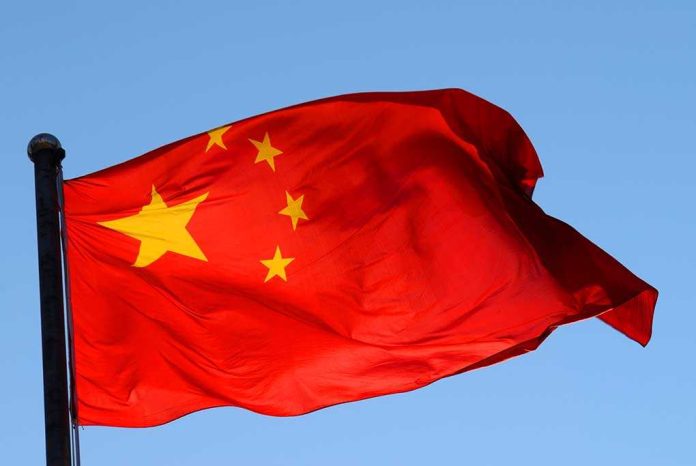
In April 2026, China’s Ministry of Natural Resources confirmed a successful deep-sea mission testing an “electro-hydrostatic actuator” described as capable of cutting armored submarine cables at depths of 3,500 meters. The public confirmation matters because it shifts the debate from theoretical vulnerability to a claimed, demonstrated capability. What remains less clear from public reporting is operational intent and how quickly such tools could be deployed at scale.
Former Pentagon official Andrew Badger, now with defense technology firm Coalition Systems, has framed undersea cables as America’s “fragile nervous system” and warned adversaries are trying to “turn the bottom of the ocean into a battlefield.” His argument rests on a core point: a cable attack can be powerful precisely because it may fall below the threshold of open war. If attribution is uncertain, policymakers can be forced into hesitation while disruption spreads.
Accidents Happen—And That’s Why “Gray-Zone” Attacks Are Hard to Prove
Distinguishing sabotage from routine damage is a major challenge. The International Cable Protection Committee estimates 150 to 200 cable breaks occur globally each year, and most are attributed to accidents such as ship anchors, fishing activity, or natural events. That baseline “noise” creates cover for intentional acts that can be denied or blamed on maritime mishaps. From a rule-of-law standpoint, uncertain attribution complicates any proportional response.
Taiwan’s experience illustrates the political sensitivity. Public reporting cited roughly 30 subsea cable incidents in recent years, including cases where Chinese vessels allegedly severed cables and disruptions lasted for months. The allegation underscores the strategic concern—cables can be targeted to pressure a society without a traditional battlefield engagement—but public information still leaves gaps on definitive proof for specific incidents. That uncertainty is exactly what makes cable threats attractive in hybrid competition.
Trump-Xi Talks and the Return of Hard-Nosed Infrastructure Politics
Warnings about cable vulnerability surfaced as President Donald Trump prepared for bilateral talks with China’s Xi Jinping in Beijing, with expected agenda items including trade, artificial intelligence, and Taiwan. In that context, undersea cable security becomes more than a technical issue; it is a bargaining-chip reality. If one side believes it can disrupt the other’s communications and markets quickly, it can influence risk calculations around everything from sanctions to deterrence.
China’s undersea cable threat raises $10T fears as Trump-Xi talks loom https://t.co/W5xEmTln6b #FoxNews
— Coffee Anytime (@coffee_anytime) May 11, 2026
On Capitol Hill, the Strategic Subsea Cables Act of 2026—introduced by Barrasso and Democratic Sen. Jeanne Shaheen—signals that cable protection is one of the few areas where bipartisan agreement can still form. The case for action aligns with limited-government common sense: even a market-driven economy needs government to secure truly critical infrastructure from foreign coercion. What is still missing in public view is how much new funding, monitoring, and repair capacity the U.S. will commit, and how quickly.
Sources:
China’s undersea cable threat raises $10T fears as Trump-Xi talks loom
centralnebraskatoday.com/national-news/