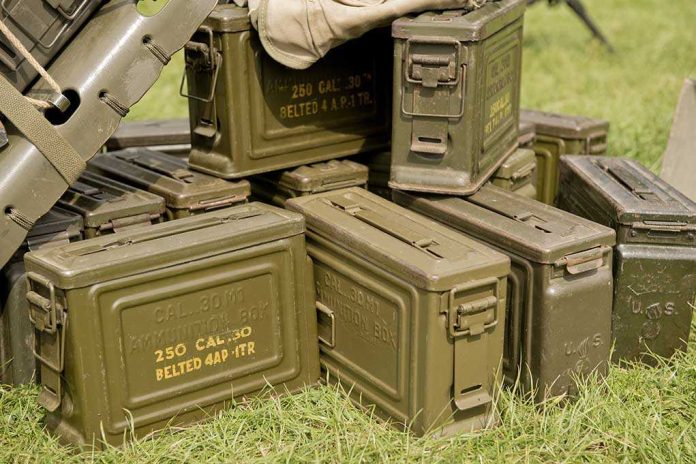
When China moves to seal off the civilian market from even its discarded weapons and hardware, it is not just tidying up surplus—it is hardening the boundary between the People’s Liberation Army and society in the name of secrecy, safety, and image management.
Key Points
- Six Chinese military, police, and regulatory bodies have jointly banned the sale of retired and scrapped military equipment and parts, both online and offline.
- The directive explicitly links the ban to past market sales that exposed “sensitive information,” creating security risks to military secrets and public safety.
- Beyond sales, the order prohibits using dismantled parts to produce or assemble imitation military equipment and forbids any commercial marketing of such items.
- A narrow exemption allows only items listed in an official catalog of “dual-use” dismantled parts or otherwise approved by the military, preserving a tightly controlled resale channel.
- The move fits a broader pattern in China’s security governance: broad restrictions on dual-use goods, justified by secrecy and safety, with limited carve-outs under direct state or military supervision.
A Sweeping Ban on Retired Military Equipment
In late July 2026, a joint notice from six central Chinese bodies imposed a comprehensive ban on commercial activities involving retired or scrapped military equipment. The signatories span the core of the country’s security apparatus: logistics and equipment departments of the Central Military Commission, the Commission’s political-legal body, the Ministry of Public Security, the State Administration for Market Regulation, and the National Defense Science and Technology Industry Administration. Together, they ordered that “any unit and individual” is strictly prohibited from selling retired military materiel that has been formally taken out of service and treated as scrap—covering weapons, ammunition, equipment, components, and related materials.
What makes this directive notable is its breadth. It is not limited to a particular platform or category of hardware; it reaches across all retired and scrapped PLA equipment, and it applies to both online marketplaces and offline channels such as auctions, surplus dealers, and memorabilia shops. The language is categorical: sales are banned unless the items fall within a specified exception regime. This is not a mere tightening of export controls; it is a domestic clampdown on how military surplus can circulate within Chinese society.
Official Rationale: Secrecy, Safety, and the Army’s Image
The joint notice does not present the ban as a hypothetical precaution. It states that “in recent years” some operators have openly sold products involving retired or scrapped military equipment that contain sensitive information, both online and offline, and that this practice has caused “adverse effects” and produced “safety hazards.” In Chinese and Korean reporting, officials explicitly tie these sales to risks for military secrets, social public safety, and the “good image” of the people’s army.
Three strands of justification run through the text. First is the protection of **military secrecy**: the concern that markings, configurations, or embedded data in discarded hardware could reveal capabilities, deployment patterns, or vulnerabilities to domestic or foreign actors. Second is **public safety**, an acknowledgment that certain retired equipment—even when scrapped—may retain explosive potential, hazardous materials, or other risk factors if mishandled. Third is **institutional reputation**: the directive speaks of safeguarding “national interests, the interests of the army, and the good image of the people’s army.” That last rationale is not strictly about operational security but about how military artifacts circulating in flea markets or on livestream platforms might reflect on the PLA’s professionalism and discipline.
The authorities clearly see the market practice as more than harmless collecting of inert souvenirs. By framing the issue as a convergence of secret-protection, safety, and reputational stakes, they justify a strong intervention that goes beyond incremental regulation, and they signal internally that leaks of physical equipment are a governance failure on par with cyber or document leaks.
Beyond Sales: Bans on Dismantling, Reassembly, and Imitation
The directive’s second layer targets what happens to retired equipment once it leaves formal channels. It explicitly prohibits any unit or individual from using dismantled parts of retired or scrapped military equipment to “produce, modify, and assemble” items that are then sold as imitations of military equipment sufficient for the public to believe they are real. In other words, it is not only illegal to sell original surplus hardware; it is also illegal to reconfigure scrap into replicas that look like PLA gear and put them on the market.
This prohibition speaks to two concerns. One is misrepresentation: imitation equipment that appears genuine could be used to deceive, to stage false authority, or to create confusion in emergencies. Another is leakage of design information: even a replica built from original parts can convey technical details that officials want kept inside the defense industrial system. The ban also forbids “any commercial marketing promotion” of retired equipment and related imitations in any form. That closes off a growing practice in China’s livestream and short-video economy, where sellers promote surplus or replica gear with dramatic narratives and imagery; under the new rules, this genre of advertising tied to PLA artifacts is off-limits.
To enforce these rules, the notice instructs relevant departments to “strengthen normalized supervision and inspection” of markets and marketing activities tied to such equipment and to strictly investigate violations that endanger public safety or military secrecy, including pursuing criminal responsibility when conduct constitutes a crime. The goal is a continuous regulatory presence rather than one-off clean-up campaigns.
A Narrow Exception: The Dual-Use Dismantled Parts Catalog
Despite the sweeping tone, the directive does carve out a small space for controlled commerce. It exempts items that appear in the officially published public-sales catalog of dismantled parts maintained by China Rongtong Asset Management Group, designated as “dual-use” (military-civil) components, along with other equipment explicitly approved by the military for sale. This catalog functions as a whitelist: only those dismantled parts that the military has classified as low-risk and suitable for civilian use may be sold openly.
China Rongtong is a state-linked asset management platform; its involvement signals that surplus disposal will be channeled through centrally supervised entities rather than dispersed through ad hoc local arrangements. In practice, the exception likely covers items such as generic industrial components or materials whose military provenance does not confer meaningful intelligence or safety risk once detached from their original systems. Everything else—complete weapons, munitions, sensitive subsystems, identifiable armor plates—falls under the ban unless individually cleared.
This structure mirrors a broader pattern in China’s governance of dual-use goods: authorities define the high-risk category widely, then construct a narrow, bureaucratically managed pathway for approved items to circulate, often through designated state-owned enterprises. It is a risk-management design that prioritizes control and centralized discretion over market-driven demilitarization standards.
Several Chinese entities, including the Ministry of Public Security and the Central Military Commission, have announced a ban on the sale of retired military equipment to prevent its unauthorized circulation and strengthen oversight of defense assets.#China pic.twitter.com/1VDSSMq9lY
— 生态中国 (@EcologicalChina) July 29, 2026
Mechanism and Enforcement: How a Security Ban Reaches the Marketplace
Mechanically, the ban operates at several points in the equipment lifecycle. At the disposal stage, units that retire equipment must now treat it as material that cannot be sold outside approved channels, closing the avenue through which scrap and surplus previously leaked into civilian markets. At the commercial stage, market regulators and police are tasked with monitoring both physical venues—such as surplus shops, antique markets, and scrap yards—and online platforms, from large e-commerce sites to niche collector forums, for listings and promotions that involve retired PLA gear or convincing imitations.
Enforcement tools range from administrative penalties—fines, business license revocation, confiscation of goods—to criminal charges when behavior is deemed to endanger public safety or compromise military secrets. Because the notice is joint, agencies can coordinate inspections and share intelligence: military departments know what has been retired and where vulnerabilities have appeared; market regulators can map sales channels; public security can pursue investigations and prosecutions.
The directive thus institutionalizes a form of “downstream secrecy control,” extending the discipline of classified handling beyond operational units into the seemingly peripheral world of scrap and memorabilia. It treats the afterlife of military hardware as part of the security perimeter, not an economic sidebar, and embeds that view into routine market supervision.
What We Don’t Know: Scale, Incidents, and Alternatives
Despite its strong language, the publicly available text of the notice and surrounding reporting leave some questions open. The directive refers generally to “part of operators” having sold sensitive retired equipment and to resulting adverse effects and safety hazards, but it does not name specific cases, incidents, or prosecutions in the text. External coverage likewise mentions the phenomenon in general terms—online and offline sales involving sensitive information—without providing numbers on vendors, transaction volumes, or documented leaks.
That lack of detail makes it difficult to assess how widespread the problem was or whether targeted measures—such as stricter demilitarization protocols, labeling requirements, or licensing—could have addressed the risk without a blanket ban. There is no public indication in the available material that such narrower alternatives were considered and rejected; the directive simply moves directly to a comprehensive prohibition with narrow exceptions.
Nevertheless, the absence of disclosed case studies does not undercut the core factual picture: a joint military–police–regulatory coalition has decided that the leakage of retired equipment into the marketplace poses a sufficiently serious risk to warrant major restructuring of surplus disposal and market oversight. For outside observers, the evidentiary gap lies in the quantitative and qualitative assessment of that risk, not in the fact of the ban itself.
Broader Pattern: Dual-Use Goods and the Tightening of Security Boundaries
The retired equipment ban is best understood as part of a broader pattern in China’s security governance. When a market practice is reframed as touching military secrecy, public safety, or the state’s image, regulators have tended to respond with broad restrictions plus narrow carve-outs rather than with incremental transparency or licensing alone. Dual-use or quasi-military goods—items that straddle civilian and military applications—are a recurring focus: authorities identify a leakage or misuse risk, define the affected category broadly, and then preserve a controlled channel for pieces deemed safe enough for authorized resale.
In this case, the controlled channel is the China Rongtong catalog of dismantled parts; the broad prohibition covers everything else. Similar logic appears in export controls on certain dual-use items and rare materials, where engineers and security officials argue that once goods leave tightly managed systems, it becomes difficult to police their eventual use, and reputational or strategic harm can be significant. The retired-equipment ban extends that logic inward, to domestic circulation, reflecting the PLA’s growing sensitivity to how even minor artifacts can intersect with cyber reconnaissance, open-source intelligence, and political narratives.
For collectors, surplus dealers, and industrial salvagers inside China, the new regime introduces uncertainty and dependence on military and state-asset discretion. Legitimate commerce in low-risk parts must align with official catalogs and approvals; anything involving recognizable PLA hardware or convincing replicas is now a potential security violation, not merely a regulatory technicality. For analysts outside China, the directive is another sign that the line between the country’s military ecosystem and its civilian markets is being drawn more sharply—and that even the junkyard is now, in the eyes of regulators, a place where secrets can leak.
Sources:
zerohedge.com, theepochtimes.com, yna.co.kr, money.udn.com, epochtimes.com, news.qq.com, news.china.com, sbhnews.com, youtube.com, acquisition.gov