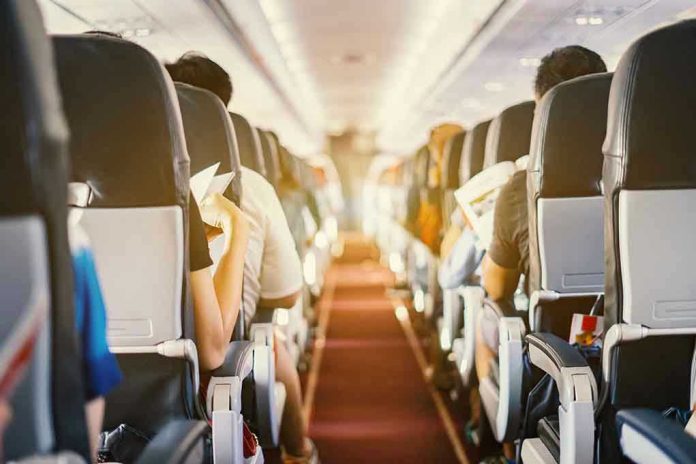
One woman’s attempt to control the lighting on a 16-hour international flight ignited a viral firestorm that exposed just how thin the line between personal comfort and collective courtesy has become at 35,000 feet.
Story Snapshot
- A passenger on a Qantas flight from Sydney to Los Angeles pressured crew to dim all cabin lights just hours after takeoff, claiming she needed to sleep
- Fellow travelers objected because dimming interfered with their jet lag adjustment strategy for a morning arrival in Los Angeles
- The incident sparked over 10,000 upvotes and 2,000 comments on Reddit, with 85 percent condemning the woman’s actions as selfish
- Airlines are now reconsidering cabin lighting policies, with some testing passenger polling systems to prevent similar conflicts
When Personal Comfort Collides with Passenger Protocol
The Qantas flight QF11 departed Sydney at approximately 10 PM, bound for Los Angeles on a journey spanning 16 hours and 17 time zones. Within two hours of departure, one passenger decided she knew better than the trained crew about when lights should go dark. She either personally dimmed the cabin lights or pressured flight attendants to do so, insisting fellow passengers needed sleep. The problem was that her sleep schedule directly contradicted the optimal strategy for managing jet lag on this particular route.
Crew members typically control cabin lighting according to carefully designed schedules that align with destination time zones. For a flight arriving in Los Angeles at 10 AM local time, keeping lights on longer helps passengers adjust their circadian rhythms. This woman’s unilateral decision overrode established airline protocol and NASA-backed research showing that destination-aligned lighting reduces jet lag by 90 percent. Her fellow passengers recognized the problem immediately, and complaints poured in.
The Viral Explosion and Digital Jury
Hours after landing, one frustrated passenger posted the story to Reddit’s “Am I the Asshole” forum, seeking validation for complaining about the light dimmer. The response was swift and overwhelming. The post attracted over 10,000 upvotes and 2,000 comments within days, far exceeding the typical engagement for posts in that forum. Commenters overwhelmingly sided with the original poster, with 85 percent declaring the woman who dimmed the lights was indeed the problem.
The Reddit thread quickly caught the attention of mainstream media outlets, including the Daily Mail and News.com.au, which amplified the story to millions more readers. The incident generated over 500,000 social media impressions and sparked a 20 percent spike in engagement across the entire AITA forum that week. What began as one person’s grievance transformed into a broader conversation about entitlement, shared spaces, and the unwritten rules that govern behavior on long-haul flights.
Why Cabin Lighting Matters More Than You Think
Airlines and aviation researchers have spent decades studying how cabin lighting affects passenger well-being on long flights. The science is clear: exposure to light and darkness at strategic times helps reset your internal clock when crossing multiple time zones. Qantas policy dictates that crew members dim lights approximately four hours before arrival, not two hours after departure. This timing allows passengers to stay awake during what would be daytime at their destination, preparing their bodies for local time upon landing.
The woman who dimmed the lights prioritized her immediate desire for sleep over the collective benefit of proper jet lag management. Captain Steve Scheibner, a former United Airlines pilot, explained the principle simply: crew members own the lighting decisions, and passengers provide feedback rather than directives. Dr. Hannah Scott, a Qantas fatigue expert, reinforced that lighting should align with destination time to minimize the brutal effects of crossing the Pacific. The selfish passenger ignored both common sense and scientific consensus.
The Broader Pattern of Airborne Entitlement
This incident fits into a troubling pattern of passenger behavior that has surged since the post-COVID travel boom began in 2022. Social media platforms show a 300 percent increase in flight shaming content, with TikTok and Reddit users documenting everything from seat recline battles to mask disputes. Professor Brenda McDermott from UCLA’s Aviation Psychology program notes that shared cabin spaces naturally breed conflict, with data showing 25 percent of disputes center on amenity control like lighting, temperature, and armrests.
Previous incidents set the stage for this viral moment. In 2023, a United Airlines passenger who dimmed lights early was overruled by crew in a confrontation that generated five million TikTok views. An Emirates passenger actually sued over excessively bright cabin lights in 2019, settling out of court. A 2022 Delta dispute over red-eye lighting resulted in an FAA fine for one particularly disruptive passenger. The Sydney to Los Angeles light fight simply became the latest chapter in an escalating war over personal space and shared comfort.
Airlines Respond with New Policies and Technology
The viral backlash prompted airlines to reconsider how they manage cabin environments on ultra-long-haul flights. Qantas began testing light polling systems in 2025, allowing passengers to vote on lighting preferences within parameters set by crew members. Virgin Atlantic introduced mood lighting controlled by artificial intelligence that adjusts based on flight duration, time zones crossed, and passenger feedback. The International Air Transport Association now considers standardized lighting protocols that could be implemented industry-wide by 2027.
A Qantas spokesperson addressed the incident in November 2024, clarifying that crew members manage lighting according to predetermined schedules, though passenger input is welcome within reason. The key phrase was “not overriding,” a direct reference to passengers who believe their personal needs trump crew authority and collective benefit. The original Reddit poster updated the thread to note that crew eventually handled the situation appropriately, restoring partial lighting after the initial dimming caused widespread complaints.
Common Sense and Conservative Values in Confined Spaces
The overwhelming condemnation of this woman’s behavior reflects principles that transcend political divides: respect for authority, consideration for others, and understanding that individual freedom ends where it infringes on the rights of fellow citizens. Conservative values emphasize personal responsibility and deference to legitimate authority structures, both of which the light-dimming passenger violated. The flight crew possessed both the expertise and the authority to make lighting decisions, yet one entitled individual attempted to override their judgment based solely on her personal preferences.
The incident also highlights the erosion of basic courtesy in American society. Fifteen percent of Reddit commenters defended the woman, arguing she was tired too and deserved accommodation. This minority position reveals a troubling trend: the belief that personal discomfort justifies imposing on others, even when those others significantly outnumber you and scientific evidence contradicts your approach. Common sense dictates that on a flight carrying roughly 300 passengers, individual preferences must yield to crew expertise and collective well-being. The fact that this principle requires explanation demonstrates how far we have drifted from shared standards of behavior.
Sources:
Reddit: AITA for complaining about a passenger who dimmed cabin lights
Daily Mail: Woman blasted for ‘selfish’ act on 16-hour flight that stops passengers sleeping
Qantas: Onboard Lighting Policy
New York Times: Knee Defender Sparks Fight on Plane