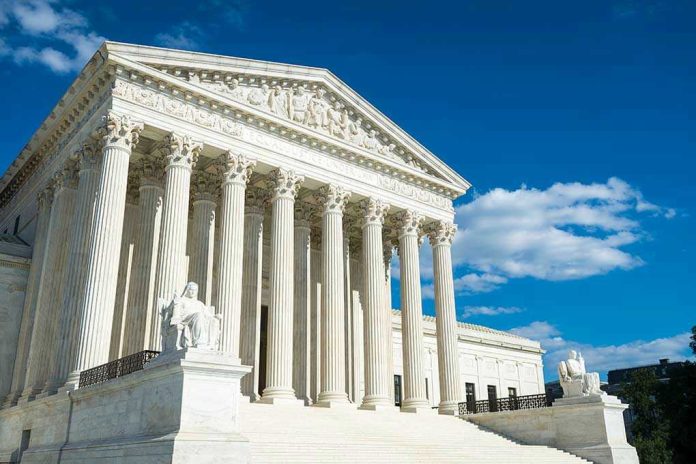
The Supreme Court drew a hard line on personal lawsuits under federal funding laws, and Justice Neil Gorsuch wrote the rule.
Story Highlights
- The Court said officers cannot face personal damages under a Spending Clause law without clear, voluntary consent.
- Justice Neil Gorsuch used contract law to explain why non-signers are not on the hook.
- Ten appeals courts had already read the law the same way; the Fifth Circuit ruling stood.
- Justice Ketanji Brown Jackson dissented, saying the rule lacks support in the Constitution and past cases.
What The Court Actually Held In Landor
On June 23, 2026, the Supreme Court held that people cannot be sued for money in their personal capacity under a Spending Clause statute unless they knowingly and voluntarily agreed to it. Justice Neil Gorsuch wrote the opinion in Landor v. Louisiana Department of Corrections and Public Safety. The Court said this tracks how contracts work: someone who did not sign cannot be sued like they did. The Court applied that to the Religious Land Use and Institutionalized Persons Act.
The ruling explained that the Religious Land Use and Institutionalized Persons Act binds the state prison system that took federal funds, not the individual officers. Louisiana’s agency accepted the deal with Congress, but the officers did not personally agree to face damages. Because the officers never consented to be sued under this federal funding condition, the money-damages claims against them could not go forward. The Court affirmed the Fifth Circuit’s dismissal on that ground.
Why Contract Principles Controlled The Outcome
Justice Gorsuch tied the result to simple contract rules. Congress may set conditions on money it gives to states. Those conditions form an agreement with the state entity that takes the cash. But a breach-of-contract suit does not reach non-signers. The same logic limits who can be sued under Spending Clause laws. Here, the state could face suits allowed by the law it accepted, but personal-capacity damages against officers require their own clear consent, which did not exist.
The Court also noted that this view matches a broad trend. Courts have been cautious about expanding individual-capacity damages under Spending Clause statutes. Ten federal appeals courts had already read the Religious Land Use and Institutionalized Persons Act to bar personal-capacity damages against officers. The Fifth Circuit had done the same, while condemning the abuse in this case but following precedent. The Supreme Court’s decision now cements that reading nationwide.
What The Case Means For Religious Liberty And Accountability
The Court did not bless what happened to Damon Landor. Lower courts recognized his religious rights were burdened. But the remedy is limited under this statute. The decision leaves injunctions and other official-capacity tools in place while cutting off personal damages without consent. Some religious liberty advocates worry this weakens accountability when officials step over the line. The Becket Fund highlighted how prior rulings have already blocked personal damages under this law.
Justice Ketanji Brown Jackson dissented. She said the new consent rule lacks support in the Constitution’s text and clashes with decades of precedent. She pointed to the Religious Freedom Restoration Act, where the Court allowed damages against individual officials, and argued the Religious Land Use and Institutionalized Persons Act should be read the same way. The majority answered that the Spending Clause frame is different and turns on voluntary agreement, which the officers never gave.
How Conservatives Should Read The Ruling
This decision guards due process and limits surprise lawsuits against individuals who never agreed to them. It reins in judge-made expansions and respects clear consent, not bureaucratic overreach. It also tells Congress: if lawmakers want personal liability, they must say so and secure real agreement from the people asked to bear it. That keeps power closer to the text and away from unelected enforcers. It supports ordered liberty and the rule of law over shifting, vague standards.
What Comes Next For Congress And The States
Congress could rewrite the Religious Land Use and Institutionalized Persons Act to make any personal-liability rule explicit and tied to real consent by covered employees. Agencies and state prisons can also improve training and notice so officers know their duties and the consequences for violations. States remain on the hook for compliance through official-capacity suits and the risk of losing federal funds. Clear rules, clear consent, and strong internal discipline can protect faith rights and accountability together.
Bottom Line For Readers
The Court said government cannot draft personal defendants into federal liability by fine print in a funding deal they never signed. That is a win for limited government and basic fairness. Religious liberty remains protected by strong injunctive tools, but money damages against individual officers will require true consent or a new law that gets it. The choice now lies with Congress and the states to set bright lines, respect faith, and uphold constitutional limits.
Sources:
reason.com, en.wikipedia.org, becketfund.org, theusconstitution.org