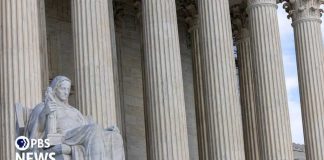
The president walked into the Supreme Court chamber on April 1, 2026, to watch justices debate whether his executive order could dismantle a constitutional guarantee that has stood for over a century.
Story Snapshot
- President Trump became the first sitting president in American history to attend Supreme Court oral arguments, breaking 237 years of precedent
- The case centers on Trump’s Day 1 executive order eliminating birthright citizenship, which lower courts unanimously blocked as unconstitutional
- The Trump administration argues the 14th Amendment has been misunderstood for decades and does not guarantee citizenship to children of non-citizens born on U.S. soil
- The ACLU warned that Trump’s physical presence should not distract the Court from defending constitutional protections affecting millions of children
- A ruling is expected by late June 2026, potentially reshaping American citizenship law
Breaking Presidential Protocol at the Highest Court
Trump sat just feet from the nine justices as Solicitor General D. John Sauer opened arguments challenging what courts have considered settled law since 1868. While presidents have attended ceremonial occasions at the Court, including investitures and funerals, none had ever watched oral arguments unfold. Trump himself visited the Court three times during his previous presidency for Justice Neil Gorsuch’s investiture in 2017, Justice Brett Kavanaugh’s investiture in 2018, and Justice Ruth Bader Ginsburg’s funeral in 2020. This appearance represented something fundamentally different: a president observing legal arguments about his own executive action.
The unprecedented nature of Trump’s attendance raised immediate questions about the separation of powers and judicial independence. ACLU Executive Director Anthony D. Romero issued a pointed statement before arguments began, declaring the organization would “school him in the meaning of the Constitution and birthright citizenship.” Romero emphasized that “any effort to distract from the gravity and importance of this case will not succeed” and expressed confidence that “the Supreme Court is up to the task of interpreting and defending the Constitution even under the glare of a sitting president a couple dozen feet away from them.”
The Constitutional Collision Over Citizenship
The executive order Trump signed on his first day in office requires parents to prove their legal status before citizenship can be granted to children born on U.S. soil. This directly challenges the 14th Amendment’s Citizenship Clause, which states that “all persons born or naturalized in the United States, and subject to the jurisdiction thereof, are citizens of the United States.” Multiple federal judges blocked the order immediately, ruling that the amendment guarantees citizenship to nearly everyone born in America, regardless of parental immigration status. The Trump administration’s appeal to the Supreme Court now asks the justices to overturn what it characterizes as a fundamental misreading of constitutional text.
Solicitor General Sauer’s opening argument framed the administration’s position starkly: the longstanding understanding of the 14th Amendment is incorrect. This represents more than a narrow legal dispute about executive authority. The government is asking the Court to reverse over 150 years of constitutional interpretation and precedent. Such a reversal would place the current Court among the most activist in American history, willing to upend settled law based on a novel reading advanced by political branches. The question isn’t merely whether birthright citizenship can be restricted, but whether courts should defer to executive branch reinterpretations of constitutional amendments whose meanings have been consistently applied across generations.
Stakes Beyond One Executive Order
If the Supreme Court upholds Trump’s executive order, the immediate impact would affect children born to parents who lack citizenship or permanent resident status. The long-term implications extend far deeper into American constitutional structure. A ruling in Trump’s favor would signal that fundamental rights and status determinations previously thought settled can be reinterpreted by executive action, subject only to Supreme Court approval. This would fundamentally shift the balance between branches and between individual rights and government power. State governments would face the burden of implementing new citizenship verification systems, and immigrant communities would confront unprecedented uncertainty about their children’s status.
The case also tests whether the Court’s conservative majority will embrace originalist methodology to reach results that contradict the original public meaning of constitutional text. The 14th Amendment was adopted specifically to overturn Dred Scott and establish that birth on American soil confers citizenship. Rejecting this understanding would require the justices to explain why the amendment’s framers and ratifiers got their own meaning wrong. Such reasoning would undermine the very originalist principles that conservative jurisprudence claims to champion. The conservative position here should align with the text’s plain meaning and the historical context of Reconstruction, not with executive convenience or contemporary policy preferences.
The Court’s Independence Under Scrutiny
Trump’s physical presence in the courtroom creates an uncomfortable dynamic for an institution that depends on public perception of its independence. The justices must render judgment on an order signed by a president sitting yards away, watching their every question and reaction. This visual spectacle threatens to reduce constitutional adjudication to political theater. The Court has spent decades cultivating an image of detachment from political pressures, insisting that judges apply law rather than make it. A president’s attendance during arguments about his own policy undermines that carefully maintained separation, regardless of how the justices ultimately rule.
The decision expected by June’s end will reveal whether the Court can maintain independence when executive power quite literally occupies the same room. A ruling that upholds birthright citizenship would demonstrate judicial backbone in defying a sitting president’s preferred outcome. A ruling that accepts the administration’s novel interpretation, however, will inevitably be scrutinized for whether Trump’s presence influenced deliberations, even if justices insist otherwise. The Court’s institutional credibility hangs in the balance alongside the citizenship rights of millions of American children. This moment will define whether separation of powers remains a meaningful constraint or merely decorative language in constitutional text.
Sources:
ABC News: Oral Arguments Underway in Supreme Court’s Landmark Birthright Citizenship Case
Politico: Donald Trump Attends Supreme Court Birthright Arguments