A single prop, a phone held like a pistol on live TV, became the pivot point in a deadly Minneapolis shooting that still hasn’t found its agreed-upon truth.
Quick Take
- A Newsmax host mimicked a handgun grip with his phone to argue ICE/Border Patrol agents could have misread Alex Pretti’s phone as a gun.
- Multiple video analyses describe Pretti holding a phone while agents fired at least 10 rounds in roughly five seconds during a chaotic scuffle.
- DHS leaders claimed Pretti “brandished” a firearm and posed a lethal threat; witnesses and frame-by-frame reviews dispute that depiction.
- The incident sits inside Operation Metro Surge and a national fight over immigration enforcement, protest rules, and use-of-force standards.
The “phone as gun” argument turns on human perception, not just politics
Newsmax’s on-air demonstration worked because it aimed at a fear every American understands: in a fast, loud confrontation, people misread objects. The host held his phone like a firearm and asked viewers to decide whether an agent could confuse it for a gun. That framing matters because it shifts the debate from what happened on video to what an officer might have believed in a split second.
That’s also why the segment drew backlash. The phone-grip claim isn’t just a courtroom-style hypothetical; it’s a cultural argument about who deserves the benefit of the doubt when things turn violent. Conservatives generally respect law enforcement and understand that hesitation can get an officer killed. Common sense also demands that claims match evidence, especially when video exists and when official statements carry immense power.
A tight timeline: pepper spray, a pile-up, and shots within seconds
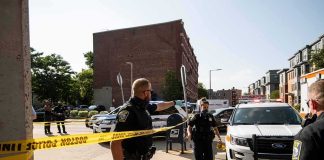
Reconstructed reporting places Alex Pretti near 26th Street and Nicollet Avenue in Minneapolis on the morning of Jan. 24, 2026, as federal agents chased someone into a donut shop. Roughly half a minute before the first shot, an agent shoved a civilian. Pretti moved toward the contact and ended up between an agent and a woman. Agents pepper-sprayed him, then more agents converged as the situation collapsed into a brief, physical scrum.
Video analyses described the critical moment as brutally compressed. Additional agents surrounded Pretti. One approached without a weapon in hand. A scuffle followed; then gunfire erupted. Accounts summarize at least 10 shots over about five seconds while Pretti was pinned. Reviews of the footage emphasize a phone visible in his right hand and no clear brandishing of a firearm at the moment shots began. Paramedics arrived minutes later and attempted CPR, but Pretti died at the scene.
The disputed firearm: recovered gun versus “brandished gun”
DHS leadership portrayed Pretti as an aggressor, including accusations that he brandished a firearm and attacked agents. Other reporting and forensic-style video breakdowns tell a narrower story: a gun existed, but the timing and possession remain the dispute. One analysis described an agent pulling a gun from within the scuffle less than a second before shots fired. That difference sounds technical, but it decides everything—self-defense against an armed suspect versus a tragedy sparked by confusion and escalation.
Pretti’s personal details poured gasoline on the argument. He was described as a VA ICU nurse with a lawful concealed carry permit. That fact alone doesn’t excuse interfering with a federal arrest, and conservatives won’t romanticize disorder just because the crowd dislikes ICE. Still, lawful carry is mainstream America, and official narratives that imply “gun owner equals threat” deserve skepticism. If the government claims a man tried to “massacre law enforcement,” it should be able to prove it clearly.
Operation Metro Surge raised the temperature before the first shot
The shooting landed in the middle of Operation Metro Surge, an enforcement push targeting urban areas amid already-heated protests after another fatal incident involving an ICE agent. That context matters because operations don’t happen in a vacuum. Agents arrive expecting hostility; protesters arrive expecting abuse; bystanders arrive with phones out because they no longer trust anyone’s press release. When trust collapses, even routine enforcement turns into a high-risk event, and every gesture gets interpreted as a weapon.
Conservative voters often support strong borders and effective removal of criminal offenders. They also expect disciplined professionalism from federal agencies. Those two ideas don’t compete; they reinforce each other. A crackdown that looks sloppy or panicked undermines legitimate immigration enforcement by handing opponents the perfect recruiting tool. If Metro Surge aims to restore order, it cannot produce scenes where agents appear unsure, overwhelmed, or slow to render aid after bullets fly.
Video forensics versus official messaging: who earns credibility?
The loudest problem for DHS isn’t a single host’s TV prop; it’s the modern evidence stack. Multiple outlets and analysts have leaned on frame-by-frame review, timestamps, and multi-angle footage. That style of verification has changed public life: it doesn’t guarantee truth, but it raises the bar for anyone making sweeping claims. When witnesses sign affidavits saying they didn’t see brandishing, and video appears to show a phone, officials can’t rely on authority alone.
That doesn’t mean every viral clip tells the whole story. Cameras miss peripheral threats, and crowds often obstruct key movements. Conservatives should resist the lazy habit of letting cable news decide what “the video proves” in either direction. The best standard is simple: match claims to what can be verified, admit what remains unknown, and punish lying—especially when it comes from the government. Credibility is public safety; people comply more when they believe they’ll be treated fairly.
The real warning is for everyone holding a phone near armed officers
The Newsmax demonstration, for all its theatricality, points to a grim lesson: phones now function like “third-party witnesses,” and that makes them flashpoints. Americans film because they fear coverups; officers fear ambushes. The answer can’t be “stop filming,” and it can’t be “assume the cops are murderers.” It has to be clearer standoff procedures, better crowd-control discipline, and rules that de-escalate rather than compress decisions into four seconds.
FUCKING DISGUSTING!! SUE THESE MOTHERFUCKERS STAT!!
Newsmax Host Holds His Phone Like a Firearm in Defense of ICE Agents Who Shot Alex Pretti: ‘Does That Look Like a Gun?’ https://t.co/TfSUmxCK4Q via @@YahooNews— NoSoyComo2 (@MateoUriarte2) January 27, 2026
Pretti’s death will likely keep riding the same track until investigators settle the basics in plain English: when the gun became visible, whose hands controlled it, and why agents fired so many rounds so quickly. Conservatives can support ICE’s mission and still insist on that clarity. Border security depends on public legitimacy. If Americans conclude that a phone can get you killed and the story will be spun afterward, enforcement gets harder, not easier.
Sources:
Protester shares dialogue with federal agent after fatal shooting of Alex Pretti