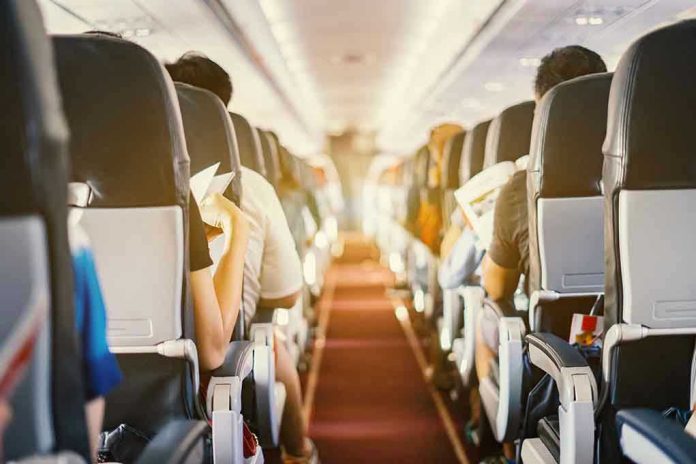
United just turned “use headphones” from a courtesy into a contract clause that can get you removed from a flight—or banned.
Quick Take
- United updated its contract of carriage on February 27, 2026 to require headphones or earbuds for any personal audio or video.
- The rule sits inside United’s “refusal of transport” language, treating loud device audio as a safety and wellbeing issue, not mere manners.
- Flight attendants can warn, provide free basic earbuds, and escalate to removal or a temporary or permanent ban.
- United appears to be the first major U.S. airline to put headphone use into the legally binding contract, not just a polite request.
United’s new line in the sand: etiquette with teeth
United Airlines quietly updated its contract of carriage on February 27, 2026, adding a straightforward requirement: if you’re listening to audio or watching video on board, you must use headphones or earbuds. The update matters because it shifts the issue from social pressure to enforceable policy. Under United’s refusal-of-transport framework, ignoring the rule can justify removal and even a permanent ban, depending on circumstances and crew judgment.
That shift explains why the story caught fire once media outlets noticed it in early March. Plenty of travelers have suffered through cabin soundtrack roulette—TikTok blasts, sports highlights, a child’s cartoon on repeat—but most airlines have relied on reminders and good will. United’s move signals something different: the airline wants the same authority over device noise that it already claims over smoking violations, disruptive conduct, and other behavior that can ruin a flight.
Why United frames loud audio as “safety,” not “annoying”
United didn’t pitch this as a campaign for politeness. The rule lives in the safety-oriented section of the contract that governs when the airline can refuse transport “on a permanent or temporary basis.” That legal placement matters. Airlines and crews operate under a safety-first command structure, and flight attendants must keep order without negotiating every boundary like a customer service desk. Labeling it wellbeing and safety gives crews clarity and leverage when someone decides rules don’t apply to them.
Common sense supports that framing. A cabin isn’t a food court; it’s a confined space with strangers, fatigue, tight connections, and stress already running high. Loud audio doesn’t just irritate; it can spark confrontations that spiral into delays, missed flights, and security involvement. Conservative values tend to favor clear standards and personal responsibility: bring earbuds, teach your kids, and respect other people’s right to peace. The alternative is the familiar modern mess—everyone policing everyone else.
How enforcement likely works: warnings first, escalation available
As of the early coverage, no reports showed a wave of immediate ejections. The practical expectation is a ladder: a reminder, then an order, then consequences if a passenger refuses. The policy also builds in an off-ramp by offering free basic earbuds through flight attendants. That detail undercuts the “gotcha” complaint. The passenger who simply forgot headphones gets a fix. The passenger who refuses after that looks less like forgetful and more like defiant.
That distinction matters because crews don’t want extra drama; they want compliance. Every on-board conflict consumes time and attention that should go to real safety tasks. A hard rule also reduces the burden on nearby passengers who currently face a bad choice: speak up and risk an argument, or suffer quietly. A contract clause gives the crew authority to intervene early, before the dispute becomes a midair showdown at 35,000 feet.
United versus other airlines: from “please” to “you agreed to this”
United’s biggest differentiator is where it wrote the rule: into a contract passengers accept when buying a ticket. That’s stronger than a friendly announcement or a half-hearted sign. Other airlines may request headphone use or state expectations without the same contract-level bite. The result is predictable inconsistency: one passenger gets corrected, another gets ignored, and the loudest person often wins through sheer persistence. United’s approach aims to standardize outcomes, not debates.
That standardization also protects the airline when things go sideways. If a disruption triggers delays, refunds, rebooking, or crew overtime, the financial impact spreads fast. Tight rules in the contract reduce arguments after the fact because the airline can point to an agreed term rather than a subjective “we prefer you don’t.” For travelers over 40 who remember when public spaces enforced norms without endless negotiation, this reads less like corporate overreach and more like overdue boundary-setting.
The real flashpoint: kids, parenting, and public standards
Etiquette expert and former flight attendant Jacqueline Whitmore publicly endorsed the change, calling it “about time,” and she pointed to a familiar source of violations: parents who let children play devices out loud. That’s the uncomfortable angle many people avoid saying out loud, yet it matches what frequent flyers describe. The policy doesn’t single out families; it sets a universal rule. Still, it forces parents to pack the basics and enforce them.
That’s where the cultural shift shows up. For years, many businesses retreated from confrontation, worried about viral videos and complaints. The result was a slow erosion of shared standards—dress codes loosened, phone speaker use normalized, and “my comfort” replaced “our space.” United’s contract update pushes back in a narrow, concrete way. It doesn’t moralize; it simply states the boundary and reserves the right to remove those who won’t follow it.
It’s way past time Passengers refusing to wear headphones on flights could be kicked off aircraft: 'It's about time' https://t.co/RvcMkBzdsR #FoxNews
— Michael Mateyk (@MichaelRMateyk) March 5, 2026
Other airlines will watch what happens next. If United sees fewer complaints and minimal conflict, competitors may codify similar rules, especially during high-volume travel seasons when tempers run short. If enforcement creates confrontations, airlines may hesitate. Either way, the era of pretending loud device audio is just “one of those things” looks shaky. United put it in writing, and that means the cabin’s unofficial soundtrack just got a lot harder to defend.
Sources:
Major US Airline Will Start Removing Passengers Who Don’t Wear Headphones
Major US Airline Will Start Removing Passengers Who Don’t Wear Headphones
United Airlines Will Now Kick Passengers off Flights for This Rude Behavior