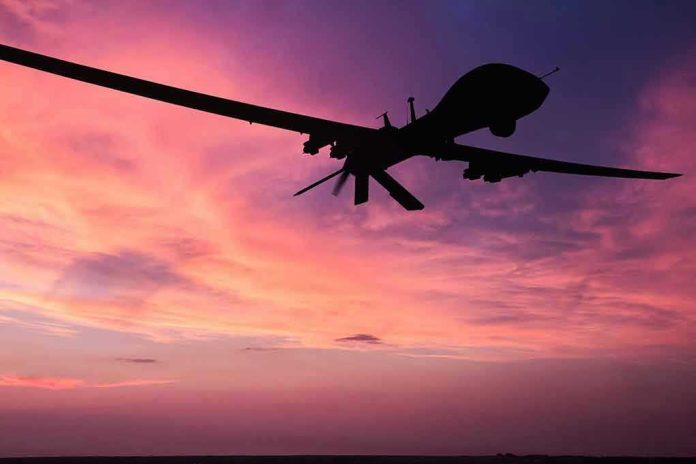
A drone strike that reportedly damaged a luxury Moscow high-rise just miles from the Kremlin is a reminder that modern war can puncture even a superpower’s “secure” capital—right before its biggest propaganda parade.
Quick Take
- Reports say a Ukrainian drone hit Moscow’s Mosfilm Tower, a luxury residential building in an elite neighborhood west of the city center.
- Moscow Mayor Sergey Sobyanin said there were no casualties and that air defenses downed two additional drones.
- The strike was reported about seven kilometers (roughly 4.3 miles) from the Kremlin and around three kilometers from Russia’s Defense Ministry.
- The incident landed days before Russia’s May 9 Victory Day Parade, a major symbol of Russian state power and wartime messaging.
What reportedly happened in Moscow—and what’s confirmed
Overnight on May 4, Ukrainian forces were reported to have launched drones toward Moscow, with one striking an upper floor of the Mosfilm Tower residential complex. Videos circulating online showed drones flying low and residents described loud explosions, while debris was reported on the ground below the building. Moscow Mayor Sergey Sobyanin publicly confirmed the incident, saying there were no injuries and that air defenses intercepted additional drones.
The key limitation is verification. Available reporting relies on official Russian statements, social media footage, and Telegram-channel claims that are difficult to independently confirm in real time. Both major accounts of the event align on the central facts—damage to the tower, emergency response activity, and no reported casualties—but details like the drone’s origin, flight path, and intended target remain unclear because Ukraine’s military did not comment at the time.
Why the Mosfilm Tower strike is politically sensitive for Russia
The Mosfilm Tower is not a remote industrial site; it sits in an elite area of Moscow near diplomatic locations and within short distance of Russia’s core political and military landmarks. That proximity is what makes the incident more than a routine air-defense bulletin. A strike in the capital’s urban core challenges the Kremlin narrative that daily life in Moscow is insulated from the war, even if damage is limited.
The timing matters even more. Russia’s May 9 Victory Day Parade is built to project strength, continuity, and control—especially during wartime. Reports framed the attack as part of Ukraine’s expanding “deep strike” campaign, and an incident close to the Kremlin days before the parade predictably raises questions about security and competence. Russia had already announced it would exclude military equipment from this year’s parade, which adds context to why symbolism is doing extra work.
What Ukraine’s deep strikes signal—and what they don’t
Ukraine’s increased use of drones against targets inside Russia reflects a shift toward asymmetric pressure against a larger military power. The stated logic in broader reporting is disruption—hitting or threatening logistics and military-industrial infrastructure that supports the invasion launched in 2022. Yet this particular incident is unusual because it reportedly damaged a residential high-rise, and central Moscow civilian-area impacts have been rare compared with strikes on more explicitly military or industrial sites.
What this means heading into May 9—and why Americans should watch it
In the short term, the most likely outcome is tighter security in Moscow ahead of May 9, with more air-defense activity and restrictions around major sites. Another likely consequence is escalatory messaging—or action—because both sides have incentives to appear resolute: Ukraine to show reach, and Russia to reassure the public. Still, the available facts do not prove a direct operational threat to the parade itself; the “threat” is mainly symbolic and psychological based on timing and distance.
Ukraine struck a luxury skyscraper 4 miles from the Kremlin, threatening Moscow's Victory Day parade.https://t.co/rzCbOfnr3n
— Mavka Slavka 🧜♀️🌻 (@MavkaSlavka) May 5, 2026
For Americans, the broader takeaway is how quickly modern conflict is normalizing long-range, relatively low-cost attacks on major cities, often with fog-of-war reporting that can be exploited by governments and online influencers alike. That reality reinforces a familiar frustration across U.S. politics: powerful institutions frequently manage narratives better than they manage outcomes. When basic truth-finding depends on adversarial officials and unverifiable clips, skepticism becomes a civic necessity, not a partisan posture.
Sources:
Luxury Moscow tower reportedly hit by Ukrainian drone strike ahead of Kremlin’s Victory Day Parade
Drone hits Moscow’s Mosfilm Tower, mayor says no casualties