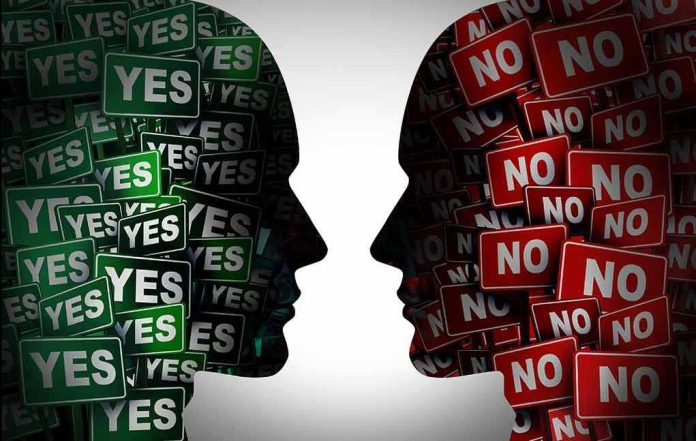
A new study reveals that 37% of Americans have severed personal relationships over political disagreements, exposing how partisan divisions are fracturing the social fabric of everyday life across the nation.
Story Highlights
- 37% of Americans ended relationships with friends, family, or romantic partners due to political differences, according to 2025 research
- Democrats were significantly more likely to initiate and report political breakups than Republicans, continuing a trend observed since 2016
- Friendships bore the brunt of political rifts, with 62% of breakups involving friends compared to 40% family and 10% romantic partners
- The increase from 15% in 2021 to 37% in 2025 suggests deepening polarization is driving Americans into isolated echo chambers
Partisan Divide Fuels Relationship Fractures
Psychologists Mertcan Güngör and Peter Ditto published research in 2025 analyzing survey data from thousands of American adults, documenting an alarming trend in political polarization’s personal toll. Their findings show 37% of Americans reported ending at least one relationship due to political differences, a significant jump from the 15% who reported ending friendships in 2021. The study, released through Indiana University and published in PNAS Nexus, identifies a pattern that accelerated following the 2016 election and intensified through subsequent political events including the 2020 election, January 6 Capitol riot, and the 2024 election cycle.
Democrats Lead in Severing Ties
The research reveals a striking partisan asymmetry in who initiates these breakups. Democrats and liberals were two to three times more likely than Republicans and conservatives to report ending relationships over politics, with some surveys showing rates as high as 27% among Democrats compared to 10% among Republicans. Earlier data from the American Survey Center found that 33% of liberal women reported ending friendships over political disagreements, with former President Trump cited as a factor in 22% of cases. This pattern suggests differing thresholds for political tolerance, with progressives demonstrating less willingness to maintain relationships across ideological lines.
Friendships Take Hardest Hit
Among the various relationship types affected, friendships suffered the most damage from political polarization. The study found that 62% of political breakups involved friendships, significantly higher than the 40% involving family members, 29% affecting coworkers, and 10% ending romantic relationships. Younger demographics, particularly Generation Z and Millennials, showed higher rates of severing social ties over political disagreements compared to older Americans. This generational pattern aligns with broader trends showing declining close friendships across American society, with political disagreements now serving as an accelerant to social isolation rather than a bridge for constructive dialogue.
Reality Check on Family Divisions
While headlines emphasize families being “torn apart” by politics, data from the American National Election Studies presents a more nuanced picture. ANES research found that only 6% of Republicans and 10% of Democrats reported major harm to family relationships from political differences, with 85-90% of families remaining largely unaffected by partisan disagreements. The Institute for Family Studies argues that media coverage overstates the severity of political rifts within families, noting that self-report bias may inflate perceived breakup rates. Additionally, 2025 research from Indiana University’s Kinsey Institute found that 40% of singles have successfully dated across party lines, suggesting that while political polarization creates real challenges, Americans retain capacity for bridging ideological divides in intimate relationships.
The trend toward political breakups reflects a concerning deterioration in Americans’ ability to engage with differing viewpoints, a cornerstone principle of democratic society. Whether driven by genuine incompatibility or media-amplified tribalism, these fractures weaken the social connections that historically enabled compromise and mutual understanding. As partisan tensions continue following President Trump’s second term and Republican control of Congress, the question remains whether Americans will rebuild bridges across political divides or retreat further into ideologically homogeneous social circles that reinforce rather than challenge their existing beliefs.
Sources:
EurekAlert – More than a third of Americans have ended relationships over politics, study finds
Civic Nebraska – Ending friendships over politics
American Survey Center – The State of American Friendship: Change, Challenges, and Loss
PNAS Nexus – Political breakups study
Indiana University Kinsey Institute – 40% of singles have dated across party lines
Skeptic Research – Severing Social Ties Over Political Disagreements
Institute for Family Studies – Are American Families Really Being Torn Apart by Politics