The federal government just turned your driver’s license into a potential $45 travel tax, and if you’re among the millions of Americans who haven’t updated your ID, every trip to the airport just became a costly gamble.
Story Snapshot
- TSA now charges $45 for travelers without REAL ID-compliant identification, starting February 1, 2026
- The fee covers only 10 days of travel validity, requiring online verification before each airport visit
- Approximately 25-30% of Americans still lack compliant identification despite 20 years since the law passed
- Complete enforcement arrives May 5, 2027, when alternative verification options may disappear entirely
The Government’s New Revenue Stream Hiding Behind Security
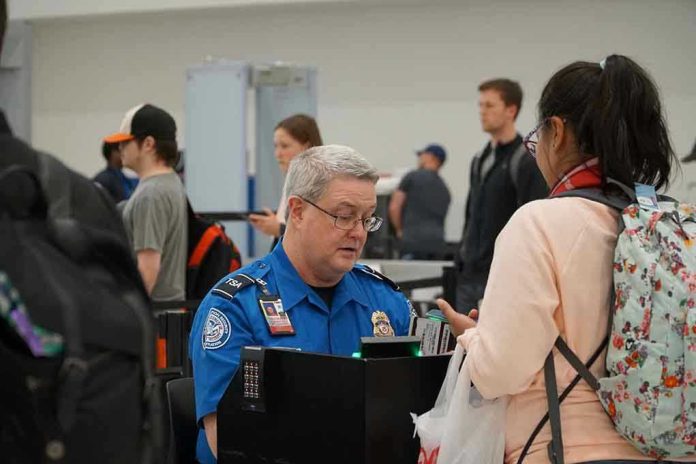
Twenty years after Congress passed the REAL ID Act in response to September 11, the Transportation Security Administration has finally discovered how to make non-compliance profitable. The new ConfirmID system doesn’t just verify your identity—it charges you $45 for the privilege of proving who you are when you forgot to get that little gold star on your license. Travelers must visit TSA.gov, submit biometric or biographical information, pay the non-refundable fee, and receive a confirmation email to present at security checkpoints. The entire process takes 10 to 15 minutes online, though in-person verification at the airport can stretch beyond 30 minutes.
No REAL ID yet? You can still fly, but it may cost $45 without another form of accepted ID https://t.co/8VSaao5Uu6
— The Boston Globe (@BostonGlobe) January 31, 2026
The fee structure reveals an interesting philosophy: your receipt remains valid for exactly 10 days, covering multiple flights within that window. For occasional travelers, this might seem reasonable. For frequent fliers who haven’t obtained REAL ID, the costs compound rapidly. A business traveler making two trips monthly could pay $540 annually for the convenience of avoiding their local Department of Motor Vehicles. The math creates a powerful incentive to comply, which likely represents the government’s actual intention. Steve Lorincz, TSA Deputy Executive Assistant Administrator for Security Operations, made clear that even after online verification and payment, TSA retains absolute discretion to deny checkpoint access if identity verification cannot be completed in person.
Two Decades of Delays Finally Meet Enforcement Reality
The REAL ID Act became law on May 11, 2005, with implementation originally scheduled for May 11, 2008. That deadline came and went as states refused to comply, citing privacy concerns, implementation costs, and federal overreach. Between 2008 and 2011, deadlines were repeatedly extended. States gradually surrendered between 2012 and 2018. By 2020, all states achieved compliance, only to see COVID-19 trigger additional postponements. Full enforcement finally began May 7, 2025, yet TSA announced flexible enforcement through May 5, 2027, allowing warnings instead of outright checkpoint refusals during the transition period.
This enforcement timeline demonstrates government patience stretched to absurdity, followed by sudden monetization of non-compliance. The law establishes minimum security standards for state-issued driver’s licenses and identification cards, requiring states to verify applicants’ identity, Social Security numbers, and lawful status. States must capture photographs, store digital images of documents, maintain electronic databases, and implement fraud prevention programs. The December 27, 2020 Consolidated Appropriations Act amended the law to accept electronic identification versions and exempted states from requiring physical Social Security cards. Every state, the District of Columbia, and five U.S. territories now issue REAL IDs, making compliance theoretically accessible to anyone willing to visit their DMV.
The Hidden Costs Beyond the Forty-Five Dollar Fee
The ConfirmID system creates more than financial burden. Low-income communities face barriers obtaining required documentation for REAL ID applications, from birth certificates to proof of residency. Elderly and disabled individuals may struggle with DMV visits requiring multiple documents and extended wait times. Rural Americans often face hours of travel to reach compliance facilities. The $45 fee becomes a regressive tax on populations least equipped to navigate bureaucratic requirements. Meanwhile, passport holders and military personnel with federally-issued identification sail through checkpoints without additional scrutiny or expense.
TRAVEL TROUBLES: Beginning Sunday, air travelers in the U.S. without a REAL ID or another acceptable form of identification, such as a passport, are subject to a new fee. https://t.co/g843fMnzA4
— WPLG Local 10 News (@WPLGLocal10) January 31, 2026
Airlines face operational complications from the new system. TSA checkpoint delays increase as officers verify ConfirmID receipts alongside standard security procedures. The industry supports REAL ID requirements as security enhancements, yet coordination challenges remain. DMVs experience surging demand from travelers finally motivated by fee avoidance rather than security compliance. The enforcement model establishes precedent for federal identity verification requirements potentially extending beyond transportation into other sectors. A tiered access system now exists where compliance status determines travel friction and cost, fundamentally reshaping the relationship between citizens and government authority over movement.
Sources:
REAL ID – Airlines for America
REAL ID Required for U.S. Travelers Beginning May 7, 2025 – Department of Defense Travel
REAL ID – Pennsylvania Department of Motor Vehicles