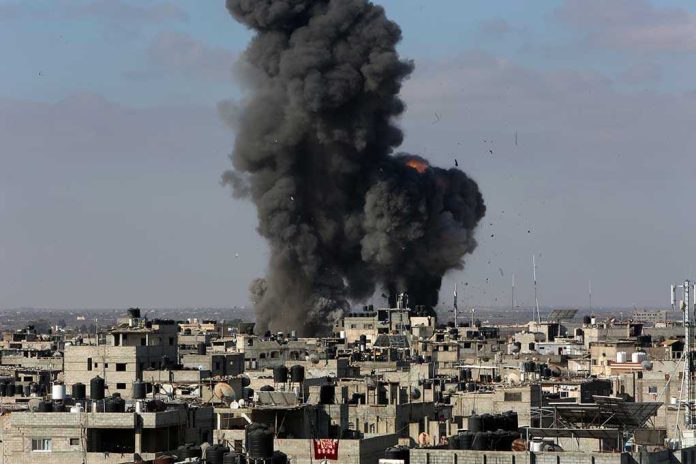
The Trump administration transformed America’s war against ISIS from a methodical campaign into an all-out annihilation strategy that crushed the terrorist caliphate in record time.
Story Overview
- Trump inherited Obama’s anti-ISIS campaign and dramatically escalated operations with “annihilation tactics”
- Coalition forces captured Raqqa in October 2017 and eliminated the last ISIS stronghold at Baghouz by March 2019
- New rules of engagement gave commanders greater authority to conduct intensive airstrikes
- Administration rhetoric emphasized total destruction with promises to “find and kill” ISIS fighters wherever they hide
Trump’s Unshackled Military Strategy
Donald Trump entered office promising to “bomb the hell out of ISIS” and quickly delivered on that pledge. Defense Secretary James Mattis implemented what he called “annihilation tactics,” surrounding ISIS fighters with no escape routes and systematically destroying them. The approach marked a sharp departure from Obama’s more cautious rules of engagement, giving field commanders unprecedented authority to launch strikes without lengthy approval processes.
The strategy paid immediate dividends. Strike volumes increased dramatically as coalition forces targeted ISIS infrastructure, leadership networks, and financial operations across Syria and Iraq. Military planners shifted from containing ISIS to completely eliminating their territorial presence, treating every engagement as part of a broader campaign to erase the caliphate from existence.
The Fall of Raqqa and ISIS Capital
The crown jewel of Trump’s anti-ISIS campaign came with the liberation of Raqqa in October 2017. Syrian Democratic Forces, backed by relentless American airpower, fought house-to-house through the terrorist stronghold that ISIS had proclaimed as its capital. The urban warfare was brutal, with coalition aircraft conducting thousands of strikes to support advancing ground troops through heavily fortified positions.
Trump called Raqqa’s fall a “critical breakthrough” and declared “the end of the ISIS caliphate is in sight.” The victory validated his administration’s more aggressive approach, demonstrating how unleashing American military power could achieve decisive results. ISIS lost not just territory but the symbolic heart of their so-called Islamic State, dealing a psychological blow that reverberated through their remaining networks.
Final Destruction Along the Euphrates
Following Raqqa’s capture, coalition forces pursued fleeing ISIS remnants down the Euphrates River valley in eastern Syria. The campaign methodically reduced terrorist-held towns like Hajin and Abu Kamal, with American special operations forces conducting targeted raids while aircraft eliminated ISIS command structures. Each victory tightened the noose around remaining fighters who had nowhere left to retreat.
The final battle at Baghouz in March 2019 marked ISIS’s territorial death knell. Thousands of fighters and their families crowded into the last pocket of caliphate territory, creating complex targeting challenges due to civilian presence. Nevertheless, coalition forces maintained pressure until ISIS’s black flag was permanently lowered, fulfilling Trump’s campaign promise to destroy their physical presence in Syria and Iraq.
Sources:
Wilson Center – Timeline US Policy ISIS
Wikipedia – Timeline of US intervention in Syria
ABC News – Timeline leading US attack Syrian airbase
Navy History – Armed Conflict Syria 2017
American Progress – Trump’s Syria Shambles