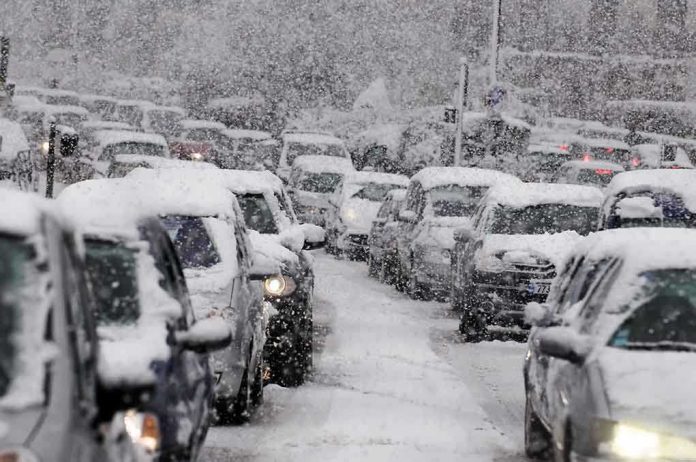
When 45 million Americans land under weather alerts in one sweep, the real story is not the snow or rain, it is how fragile everyday life looks when the atmosphere decides to go on offense.
Story Snapshot
- A powerful winter storm is hammering the Northern Plains and Midwest with dangerous road conditions and blizzard-style impacts.
- At the same time, an atmospheric river is dumping up to a foot of rain on parts of Washington state, raising flooding and landslide risks.
- Roughly 45 million Americans are under some kind of weather alert from these overlapping systems.
- Some regions are getting hit “on the heels of the biggest December snowstorm in years,” with more snow and bitter cold lined up.
One Weather Pattern, Two Very Different Threats
ABC’s “45 million Americans under alerts as new storms take aim” is not about a single messy commute; it is about a continental-scale pattern putting huge swaths of the country under pressure at the same time. The same overarching Pacific-driven pattern that feeds a moisture-loaded atmospheric river into Washington also drives a powerful winter storm east into the Northern Plains and Midwest, where entrenched cold air turns that moisture into heavy snow, whiteouts, and treacherous highways.
The Midwest and Northern Plains pay in ice, snow, and visibility measured in yards; the Pacific Northwest pays in relentless rain, rising creeks, and saturated slopes that do not care where property lines or county budgets begin. That two-front, multi-hazard reality is why alerts stack up so quickly: winter storm warnings, advisories, blizzard warnings, flood watches, and more, all born of the same high-energy pattern but translated into different local threats depending on temperature and terrain.
The Compounding Cost of Back-to-Back Storms
In the central Appalachians, meteorologists already described an earlier system as the “biggest December snowstorm in years,” then promptly issued a new weather alert for yet another widespread snow event hitting Friday. Blizzard warnings are going up in higher-elevation counties such as Garrett in Maryland and Preston and Tucker in West Virginia, where forecasters expect gusts over 45 mph, heavy snow, and near-zero visibility. That is not a one-off inconvenience; that is an early-season stress test of every plow, salt pile, and rural power line in the region.
Storm sequencing is where common sense and conservative instincts about resilience kick in. Families, small businesses, and local governments can handle one major storm. A second, on the heels of “biggest in years,” quickly exposes thin margins: worn-out road crews, strained budgets for overtime and fuel, and residents whose pantry, medications, or heating arrangements were never meant for serial disruption. The pattern promises a sharp cold blast in the wake of the storms, with temperatures diving into the teens and single digits in places, so what begins as a snow event ends as a test of home insulation and grid reliability.
Who Really Holds the Power When the Alerts Light Up?
The National Weather Service and NOAA hold the technical authority that quietly underpins those “45 million under alert” headlines. Their meteorologists pull the trigger on winter storm warnings, blizzard warnings, and flood alerts that ABC and its affiliates amplify nationwide. Local emergency managers, state transportation departments, and school districts then translate that data into real-world decisions: travel restrictions, road closures, early dismissals, and whether to spend scarce dollars pre-positioning crews or gambling that forecasts might be overdone.
WATCH: 45 million Americans under alerts as new storms take aim https://t.co/Rgku3CNOFV
— KMET1490AM (@KMETRadio) December 10, 2025
For viewers, the ABC segment compresses all this into a short, high-impact briefing built around a single number: 45 million. That framing works because it taps a basic human signal—scale equals seriousness—without getting lost in technical jargon. But it also masks a quieter imbalance: residents in rural corridors, from the Dakotas to mountain hollows in West Virginia, often bear the brunt of closures and outages with fewer backup options than the urban viewers who see the graphic and move on.
What These Storms Reveal About American Preparedness
Multi-hazard storms like this expose how much of American “normal life” depends on smooth logistics and functioning infrastructure the public rarely thinks about. Trucking routes across the Northern Plains and Midwest do not just deliver holiday packages; they move food, medicine, and fuel that metro areas assume will always arrive on time. When blizzard conditions shut interstates, schedule buffers disappear, and even a day or two of lost time can ripple into bare shelves or delayed prescriptions hundreds of miles away.
On the West Coast, an atmospheric river delivering up to a foot of rain in parts of Washington tests drainage systems, levees, hillside stabilization, and emergency communication all at once. Conservative common sense says you do not solve that with slogans; you solve it with disciplined maintenance, realistic land-use decisions, and infrastructure sized for the extremes you know will recur. When storms cluster early in the season—“biggest in years,” followed by another alert, followed by a flood-prone atmospheric river, they offer a blunt audit: which communities invested in basic resilience, and which gambled on luck and short memories.
Sources:
ABC News – 45 million Americans under alerts as new storms take aim
KVNU Talk – Video: 45 million Americans under alerts as new storms take aim
95.3 The Bee – WATCH: 45 million Americans under alerts as new storms take aim
WCHS – Weather Alert Friday for Another Widespread Snow Event