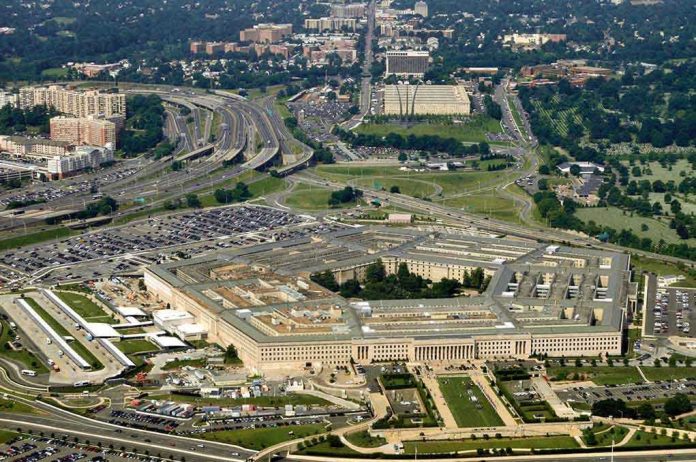
The Pentagon cannot account for trillions in taxpayer dollars, failing its financial audit for the eighth straight year just as budgets soar to record highs.
Story Snapshot
- DoD failed FY2025 audit on December 19, 2025, marking eighth consecutive failure since 2018 mandate.
- Auditors found 26 material weaknesses, including unreported F-35 spares worth billions.
- Assets and liabilities total $4.65-$4.7 trillion with unreliable internal controls.
- New leadership under Trump appointees like Pete Hegseth pledges acceleration toward 2028 clean audit goal.
- Released one day after $901 billion NDAA signing, highlighting spending amid accountability gaps.
Pentagon’s Eighth Consecutive Audit Failure
Congress mandated annual DoD financial audits in the FY2018 NDAA to ensure accountability for the world’s largest agency. The Department of Defense released its FY2025 audit results on December 19, 2025, confirming another failure. Auditors issued no clean opinion due to 26 material weaknesses and two significant deficiencies in financial reporting. These issues prevent reliable statements on $4.65 trillion in assets and equivalent liabilities spread across 4,500 locations worldwide.
DoD Comptroller Jules Hurst reported one weakness closed and another consolidated, showing minor progress. However, systemic problems persist in inventory, real estate, and fund balances. The F-35 Joint Strike Fighter program’s Global Spares Pool emerged as a prime example: auditors discovered unreported assets with impacts too vast to quantify immediately. This omission underscores deeper tracking failures in high-value programs.
Historical Roots of Financial Dysfunction
GAO designated DoD financial management high-risk in 1995, citing waste and fraud. Pre-audit scandals included $7 trillion in unverified adjustments and $2.3 trillion without receipts. The Navy lost track of $3 billion in equipment, while 58% of inventory proved unneeded, totaling $36.9 billion. Backlogs forced duplicate purchases, inflating costs. No major federal agency matches DoD’s zero-pass record over eight years.
FY2024 marked seven failures, with nine sub-audits passing—up from prior years—but 15 lacked data and one contained errors. Congress tied future funding to a 2028 clean audit in the FY2024 NDAA. GAO predicts continued failures through that deadline, given the agency’s decentralized structure across 50 states and 40 countries.
New Leadership Faces Entrenched Challenges
Pete Hegseth, confirmed as Defense Secretary, calls audits essential for taxpayer efficiency. He prioritizes budget reviews amid “decades of war and neglect.” Hurst demands “significant acceleration” in FY2026 to shift trajectory. Senate confirmed new Comptroller Michael Powers on the same day as the report release; he pledged concrete milestones. Trump signed the $901 billion FY2026 NDAA on December 18, 2025, nicknaming DoD the “Department of War” to signal reform.
These appointees inherit a beast: $9.4 trillion reviewed in the audit. Incremental gains exist, like sub-audit successes, but experts like Taxpayers for Common Sense argue flawed systems require decades to fix. Common sense aligns with conservative demands for fiscal restraint—pouring billions into unaccountable ledgers erodes trust and invites waste, contradicting promises of lean government.
Implications for Taxpayers and National Security
Short-term, misstatements risk inefficient spending on essentials like F-35 parts, vital for readiness. Long-term, 2028 failure triggers NDAA penalties, potentially curbing budgets amid rising debt. Taxpayers bear unaccounted billions; contractors face scrutiny. Politically, it fuels oversight from Congress and watchdogs. Broader effects ripple to the defense sector, demanding reforms in the industrial base.
DoD optimists tout progress; GAO pessimists foresee no quick fix. Facts support skepticism: eight failures prove entrenched issues outweigh tweaks. American conservative values prize accountability—Hegseth’s push resonates, but delivery matters. Without real change, $900 billion authorizations mock fiscal responsibility, leaving national security vulnerable to internal rot.
Sources:
Pentagon Fails Financial Audit for 8th Year In A Row
Pentagon fails financial audit for 8th year in a row
Pentagon fails another audit, restates 2028 goal to finally pass
Has the Pentagon Failed its 7th Audit in a Row?
Why Can’t the Pentagon Pass an Audit?
GAO Report on DoD Financial Management
Pentagon Achieves Uninterrupted Success in Annual Financial Audits for Nine Years