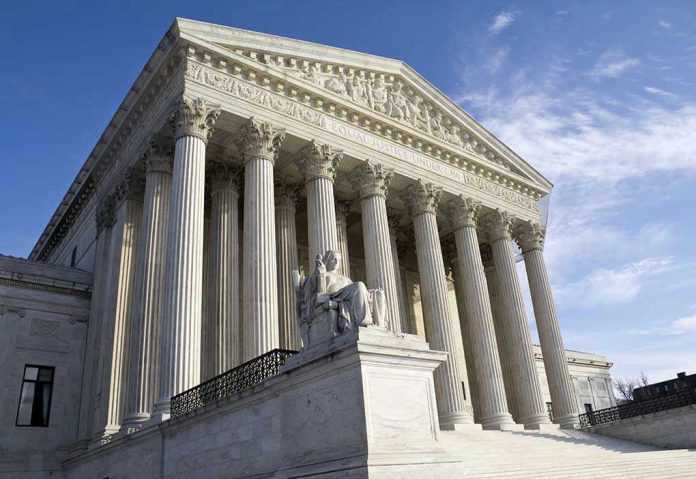
The Supreme Court’s potential decision to allow the President to fire the FTC commissioner at will could redefine the balance of power between the presidency and independent regulatory agencies.
Story Snapshot
- Supreme Court considers overturning a 90-year precedent on agency independence.
- Trump’s case challenges the protections for FTC commissioners against at-will removal.
- A ruling could enhance presidential control over independent agencies.
- Conservative justices appear inclined to support Trump’s position.
Supreme Court’s Deliberation on Presidential Power
The U.S. Supreme Court is at the center of a potentially transformative moment, as it considers whether the President should have the power to remove the Federal Trade Commission (FTC) commissioners at will. This case, backed by Donald Trump, challenges the long-standing precedent set by the 1935 decision in Humphrey’s Executor v. United States, which currently protects FTC commissioners from being dismissed without cause. If the Court rules in favor of Trump, it could significantly expand presidential authority over independent regulatory agencies, reshaping the administrative landscape.
The case not only tests the limits of presidential power but also threatens to dismantle the legal framework that has governed independent agencies for nearly a century. Conservative justices have shown openness to the idea of granting the President this expanded power, though there is also consideration of whether to limit the decision to the FTC or apply it to all independent multi-member commissions.
The Legal Precedent at Stake
The 1935 decision in Humphrey’s Executor v. United States established that Congress could protect FTC commissioners from at-will removal, distinguishing them from purely executive officers. This case became a cornerstone for maintaining the independence of agencies like the FTC, SEC, and FCC. Over the years, subsequent rulings such as Seila Law v. CFPB and Collins v. Yellen have chipped away at these protections but stopped short of overturning Humphrey’s Executor. This current challenge represents the most direct threat to the precedent, with the potential to reshape the balance of power between the presidency and Congress.
In recent years, the Supreme Court has shown a tendency to bolster presidential control over executive officers, aligning with a broader conservative agenda to limit the administrative state. By potentially siding with Trump’s argument, the Court could signal a shift toward a more unitary executive model, which would enhance presidential control over independent regulators.
Potential Fallout and Consequences
A decision allowing at-will removal of FTC commissioners could have far-reaching implications. It would likely result in rapid changes in leadership and policy direction within the FTC and similar agencies, as new administrations could swiftly replace commissioners. This could lead to more frequent shifts in regulatory approach, impacting sectors like antitrust enforcement and consumer protection. The stability and predictability that businesses and consumers rely on could be undermined, as regulatory policies become more susceptible to political influence.
Moreover, such a ruling could further erode the legitimacy of independent agencies, as they become more closely aligned with the political priorities of the sitting President. This shift could also embolden efforts to challenge the constitutionality of other independent agencies’ structures, leading to a cascade of legal battles and increased uncertainty in regulatory governance.
Broader Implications for Governance
The Court’s decision could reshape the dynamics of American governance, altering the separation of powers between the executive branch and independent regulatory bodies. By potentially curtailing Congress’s ability to create insulated commissions, the ruling would represent a significant doctrinal victory for those advocating for a stronger, more centralized executive branch. This reconfiguration of power could have lasting impacts on how regulatory agencies operate and interact with both the executive branch and the industries they oversee.
As the nation awaits the Court’s decision, the outcome of this case could redefine the contours of presidential authority and the role of independent regulatory agencies in the American political system. It raises fundamental questions about the nature of executive power, accountability, and the balance of governance in a rapidly changing political landscape.