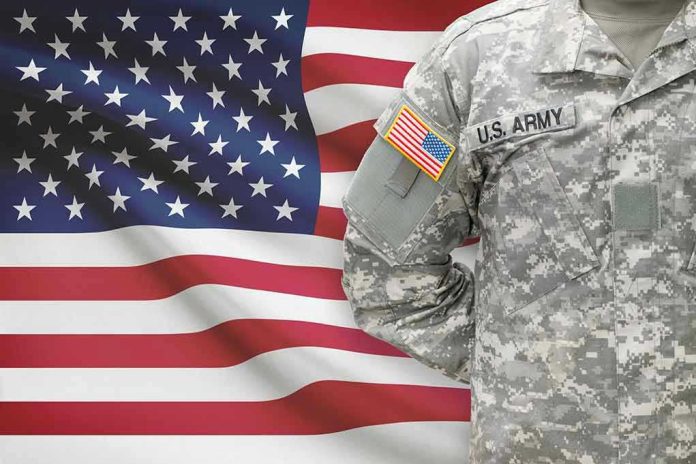
One obscure court ruling over who can wear a uniform tells you everything about who really runs America and who gets pushed to the curb when politics replaces common sense.
Story Snapshot
- A federal appeals court in Washington, D.C., backed the Trump administration’s ban on transgender troops.
- The judges accepted the Pentagon’s argument that military readiness can outweigh individual identity claims.
- The ruling exposes a deep clash between social engineering and mission-first national defense.
- The decision’s logic will echo far beyond barracks and bases into every major institution.
A court decision that quietly redrew the lines of military policy
The Trump administration’s policy restricting transgender service in the U.S. military did not collapse in a blaze of outrage on social media; it survived in the quieter, more consequential arena of a federal appeals courtroom in Washington, D.C. Judges on the U.S. Court of Appeals for the D.C. Circuit upheld the administration’s position, signaling that, at least for now, the military can prioritize cohesion, readiness, and deployability over evolving gender identity norms inside civilian culture.
This was not a casual judgment about personal lifestyles; it was a legal endorsement of the idea that the armed forces occupy a unique category where the usual rules of social experimentation do not automatically apply. The court effectively said that when commanders and defense officials claim a policy is needed to maintain combat effectiveness, they receive substantial deference. That does not mean they are always right, but it does mean judges will hesitate to overturn a policy unless it clearly tramples constitutional limits.
What the ban said about who may serve and on what terms
The policy, as crafted during the Trump years, did not technically expel every person who identified as transgender, but it did place strict conditions on who could join and under what medical circumstances they could remain. Requirements centered on whether individuals had been diagnosed with gender dysphoria and whether they had undergone transition-related treatment. The Pentagon argued that long-term hormone therapy, specialized medical needs, and non-deployable periods could disrupt unit readiness in ways the military could not easily absorb.
Critics called this a thinly veiled attempt to push transgender individuals out of service, pointing to previous years in which some had served without high-profile incidents. Supporters countered that the issue was not whether a motivated individual could do the job on a good day, but whether entire force structures could plan, deploy, and fight reliably when a portion of the ranks required sustained medical accommodation. From a conservative, mission-first lens, the policy looked less like discrimination and more like a hard-edged application of the same standards that already ground out many would-be recruits for medical or psychological reasons.
The legal logic: deference, security, and constitutional boundaries
The appeals court did not proclaim the ban morally superior or socially desirable; it evaluated whether the administration’s policy crossed constitutional red lines and whether the military’s judgments deserved weight. Courts have long treated the military as a distinct institution where Congress and the executive branch enjoy broad discretion, especially when policies tie directly to operational effectiveness. The D.C. Circuit essentially accepted that the Pentagon had supplied enough rationale, not perfect, but sufficient, to avoid being labeled arbitrary or unconstitutional.
From a rule-of-law standpoint, this matters more than hashtags or headlines. A court that insists every military personnel rule align with the latest campus diversity manifesto would undermine civilian control in an odd way, replacing elected and appointed leaders with judges as de facto chiefs of staff. The ruling instead reinforced a more traditional separation of roles: elected branches set military policy within constitutional guardrails, and courts step in only when those guardrails clearly crack.
The culture clash behind the uniforms and beyond the barracks
Beneath the legal language lies a sharper cultural question: Is the U.S. military primarily a fighting force or primarily a laboratory for identity politics? Advocates for broader inclusion argue that denying open service to any group offends equality and sends a harmful message about who counts as fully American. Those aligned with a more conservative, common-sense framework answer that the military’s overriding responsibility is to deter and defeat enemies, not validate every personal identity journey, no matter how sincere.
The court’s decision implicitly sided with the latter framing by elevating lethality, cohesion, and readiness above symbolic representation. That does not settle the moral debate, but it clarifies which value holds legal priority inside the armed forces today. The same tension now plays out in police departments, corporate HR offices, and public schools, each wrestling with whether performance metrics or identity metrics come first when the two collide.
Why this obscure ruling still matters to you years later
Many people treat this case as a niche skirmish over a small population, but the precedent reaches into how future administrations will handle everything from medical waivers to mental-health standards and physical fitness benchmarks. If the military can reassert mission-first standards in the face of cultural pressure, other institutions may feel bolder about resisting policies that dilute performance in the name of ideological conformity. If later courts reverse course, expect deeper judicial involvement in the fine-grained management of national defense.
For Americans who value constitutional order, strong defense, and clear lines of authority, the ruling offered a glimpse of a judiciary still willing to respect the unique demands of military life. For those who prioritize expansive notions of individual expression above institutional function, it signaled a serious obstacle. Either way, the decision shows how a single case about who may wear a uniform reveals the broader struggle over what kind of country those uniforms are sworn to defend.