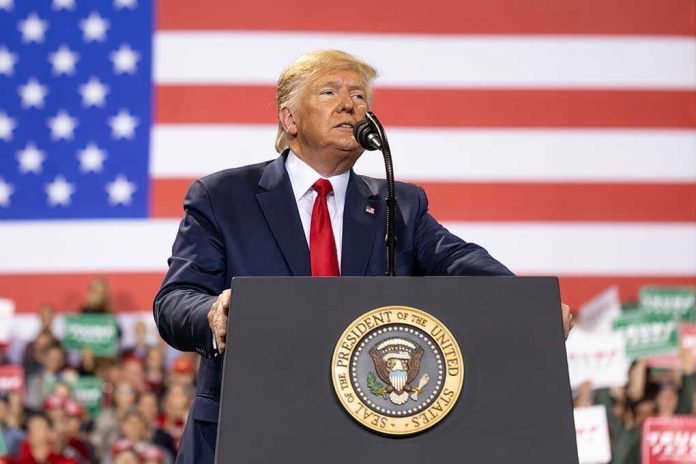
Trump just promised to pull a $200 billion lever in the mortgage market that could jolt housing, Wall Street, and taxpayers all at once, and no one yet knows whether it is precision surgery or a political stunt with a very real price tag.
Story Snapshot
- Trump announced a directive for Fannie Mae and Freddie Mac to buy $200 billion in mortgage bonds to push mortgage rates down.
- The plan currently exists as a Truth Social order, not as a fully documented policy with legal and operational details.
- GSEs appear to have regulatory headroom to expand their mortgage-backed securities holdings by roughly this amount.
- Economists warn that rate tinkering without new housing supply may backfire on long-term affordability and taxpayers.
Trump’s $200 Billion Housing Gambit, Stripped to the Basics
Donald Trump did not roll this out with a White House signing ceremony; he fired it off on Truth Social. He said that because Fannie Mae and Freddie Mac now have roughly $200 billion in cash, he is instructing his “representatives” to use that firepower to buy $200 billion in mortgage bonds. He framed the move as a way to drive mortgage rates down, lower monthly payments, and “bring back the American Dream” of homeownership for squeezed families.
Here is the catch seasoned homeowners will immediately sniff out: as of now, this is a political directive, not a signed program manual. Treasury, the Federal Housing Finance Agency (FHFA), and the GSEs themselves have not released a term sheet, a timeline, or even a plain-English FAQ. What exists is a public order to entities still in federal conservatorship, plus a swirl of media explainers, market speculation, and campaign-style rhetoric tying the action to Biden-era housing “failures.”
How Government-Sponsored Giants Became Trump’s Housing Weapon
Fannie Mae and Freddie Mac did not become central to this story overnight. Washington placed them into federal conservatorship in 2008, after their near-collapse during the financial crisis, and capped how many mortgage-backed securities (MBS) they can hold. Over the years their portfolios shrank, but the bailout agreements still leave room for more. Current estimates put their MBS holdings around $234 billion, with roughly another $200 billion of allowable headroom. That regulatory ceiling is the space Trump now wants to fill in one enormous gulp.
The logic is straightforward in textbook terms. Flood the market with a giant new buyer of mortgage bonds, push bond prices up, pull yields down, and narrow the unusually wide spread between 30-year mortgage rates and 10-year Treasuries that opened after 2021. In theory, that should drag mortgage rates lower for borrowers, mirroring on a smaller scale what the Federal Reserve did when it amassed roughly $2.7 trillion in MBS during and after the Great Recession and the pandemic. In practice, the real-world impact will depend on pace, design, and whether markets believe the government will stay the course.
Housing Crisis, Populist Anger, and the Wall Street Villain
This proposed MBS binge does not stand alone; it rides shotgun with another Trump promise: banning large institutional investors from buying single-family homes. One day before the bond directive, he pledged to stop big Wall Street players from competing with families in the for-sale market, tapping into deep resentment in both red and blue zip codes. Social media creators instantly branded the combined agenda as Trump “declaring war” on the housing market and corporate landlords, selling it as a populist housing reset.
The grievances are real. After the 2008 crash, underbuilding, tight zoning, and then the pandemic boom created a chronic housing shortage. Many existing owners locked in sub‑3% mortgages, choking inventory, while rising rates and sticky prices boxed out first-time buyers. Voters now blame a mix of Fed policy, inflation, and deep-pocketed investors. By ordering a $200 billion rate-relief push and threatening an investor ban, Trump positions himself as siding with households over Wall Street, even as he leans on quasi-public balance sheets that ultimately rest on taxpayer backing.
Can $200 Billion Really Fix Affordability or Just Shift Risk?
Conservative instincts demand a basic question: does this plan solve the problem, or just shuffle the risk from private markets onto federal ledgers? Economists largely agree that housing’s core issue is supply, not just financing costs. Cheaper mortgages without more building can spark demand into a constrained inventory, which may support or lift prices rather than deliver lasting affordability. That tradeoff aligns poorly with common-sense stewardship: temporary sugar highs are not a substitute for structural reform.
The other concern runs straight through the GSEs’ history. Fannie and Freddie already required a taxpayer-backed rescue once. Loading an additional $200 billion in MBS onto their books concentrates interest-rate and credit risk in entities that remain in conservatorship and whose obligations markets view as implicitly guaranteed by Washington. Supporters can argue that unused headroom exists precisely for moments like this, and that no new Congressional appropriation is required. Skeptics will counter that “no appropriation” does not mean “no cost” if things go wrong and taxpayers again stand behind the curtain.
What to Watch Next Before You Believe the Headlines
Seasoned readers should ignore the breathless “housing bailout” thumbnails and focus on three proof points. First, watch FHFA: any serious implementation will show up as formal guidance on how, when, and what kinds of MBS Fannie and Freddie will buy. Second, watch Treasury, which must reconcile this political order with the 2008 bailout covenants that limit portfolio growth. Silence from both would signal campaign messaging more than imminent market intervention.
Third, watch mortgage rate spreads over time, not just headline averages. If a $200 billion program materializes, the sign of real bite will be a persistent narrowing of the gap between mortgage rates and Treasuries, not a one-day wobble. For families trying to buy, a few tenths of a point might help at the margin. For taxpayers, the bigger question is whether that modest relief justifies ramping up the GSEs’ exposure again, while the deeper work of freeing up land, streamlining permits, and unleashing private building still waits on the sidelines.
Sources:
Business Insider: Trump said ‘representatives’ will buy mortgage bonds
Washington Examiner: Trump says US will buy $200 billion in mortgage bonds to lower rates
The Independent: Trump mortgage bonds move via Fannie and Freddie
Fox Business: Trump vows to slash mortgage rates and revive the American Dream
ResiClub Analytics: Trump directs Fannie Mae and Freddie Mac to buy $200 billion in mortgage bonds